Showing posts with label Emerging Technologies. Show all posts

Tuesday, March 3, 2015

Emerging Technologies and the NMC Horizon Report

Last week I facilitated  a workshop called  "Emerging Technologies: What's on the Horizon?" It's an interesting topic which always evolves into some great conversations about emerging technologies and implications for current and future students, learning and instruction. I also really enjoy it because it has a lot of demonstration and "hands on" time.

We designed this workshop based on the New Media Consortium and the Educause Learning Initiative's yearly "2014 Horizon Report" which examines "the key trends, significant challenges, and important technological developments that are very likely to impact changes in higher education across the world over the next five years." If you are unfamiliar with this yearly publication, I highly recommend that take a few minutes to peruse it. (The 2015 Horizon Report report was just released a couple of weeks ago). Whether your an instructor, an administrator, or a member of your school's IT staff, the information in the Horizon report will be pertinent to teaching, learning, and planning for what's ahead in the name of what's best for our students in relation to emerging educational technologies.

Below is a summary of the three key areas that the report addresses:
  1. Key Trends Accelerating Technology Adoption in Higher Education
  2. Significant Challenges Impeding Technology Adoption in Higher Education
  3. Important Developments in Educational Technology for Higher Education
In the workshop, I tend to focus more on #3 above, which are the actual tools/technologies that the report sees being widely adopted in the next 1-5 years.While all three areas are important, I like to get people engaged with the tools/technologies whenever possible. Below is a list of links to the presentations I used and some of the various tools that were discussed or demonstrated.
Additional Links to some of the technologies that were demonstrated or used during hands-on time:
Again, I encourage you to read the free 2015 Horizon Report. It is a publication that is both interesting and valuable as we in higher education try to stay aware of "emerging technologies likely to have an impact on learning, teaching, and creative inquiry in education."
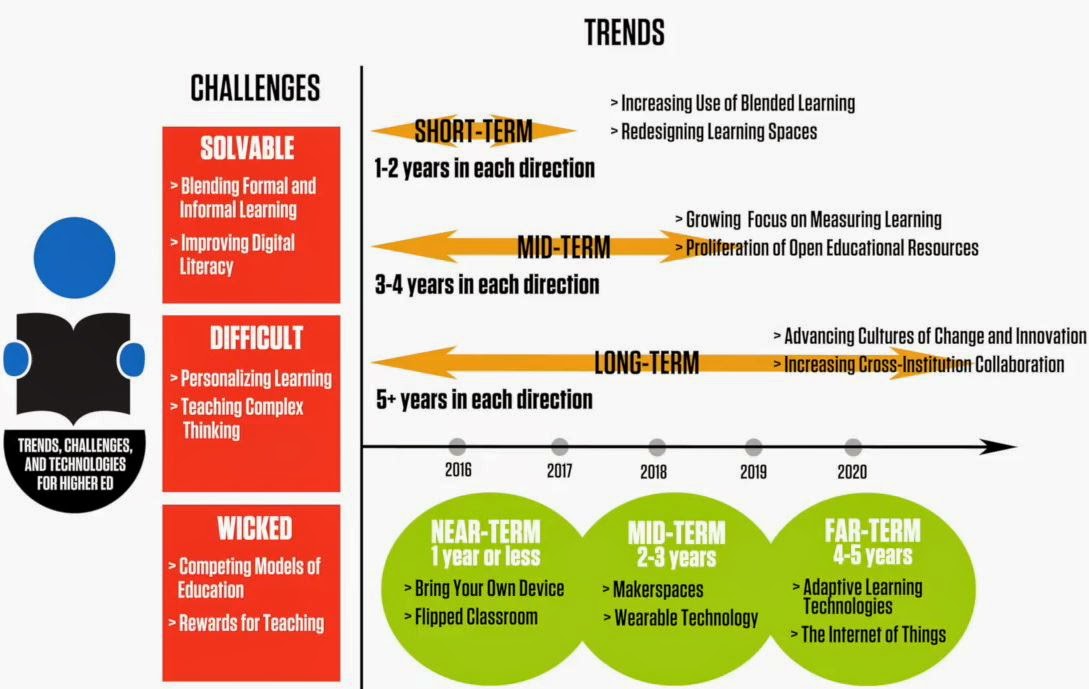
Summary of the Key Area of the 2015 NMC Horizon Report
Summary of the Key Areas of the 2015 NMC Horizon Report
Keep Calm and Barry On!
Barry

Monday, February 9, 2015

Internet of Things / Internet of Everything

Today I'm trying to wrap my around the Internet of Things and implications for education. The Internet of Things IoT has a variety of definitions. A simple definition might be A physical object that...
  • has network connectivity
  • can send/receive data
  • can communicate with other smart devices
The Internet of Things (IoT) is also known as The Internet of Everything (IoE), which CISCO defines as 'the intelligent connection of people, process, data and things.has a variety of definitions.' I tend to think of the IoT as the smart objects themselves, whereas the IoE includes the bigger picture of what can result from the combination of these smart objects with connectivity-automation, data collection, decision-making, convenience, cool toys, more efficient homes and cities, etc. Just know that the terms are often used synonymously.

In the good old days, the internet was found only on personal computers. It's been fascinating to see things go to mobile devices and now moving to smart objects. I had to get a new garage door a few years ago-I recall reading the documentation and being amazed that there was an option to connect my console to my router. At first I was like, What? Why? but then it began to make sense. I could get a report of when the garage door was opened (what time time did my teenagers get home?), I could let the UPS driver into the garage to make a delivery by pressing a button on my phone app, then close the door after he leaves, etc. Other recent examples I recall are smart thermostats like NEST, and smart door locks which will recognize people and only let authorized people in, send reports of who came in and when, and can even take and send a picture of who is at your door through your phone.

I'm also amazed at the automation that is possible with connected objects and smartphones. An example is the If This Then That (IFTTT) website which lets users set up automation based on their phones, smart objects in their homes, and commonly used web site. For example...
  • If the weather forecast calls for rain, then send me a text reminding me to grab an umbrella
  • If I get near my workplace, automatically silence my phone
  • If I leave for work, then turn off my lights (or down my furnace)
  • If a player on my fantasy baseball team gets hurt, send me a text
You get the idea-some are downright silly and for fun, but some of these automatons can provide you with valuable instant information or result in a more efficient energy bill.

The data collection can also be incredibly useful. Think about the data that is collected from a fitbit and how it can help someone monitor their own health. I have also read recently about a smart bra that can help detect breast cancer and using smart objects to reduce traffic congestion.

As far as education, I can see some interesting implications. Could you easier collect data on students to better personalize their education? Could a student with low vision have the words on a computer screen automatically enlarged? Monitors in PE class? Checkout this CISCO article on IoE in Education.

There are several new smart object products that could be valuable in teaching critical and higher order thinking skills, support Science, Technology, Engineering and Math goals, and equip students with the skills necessary for their future workforce in an engaging way. Think of Lego Mindstorms, Littlebits CloudBit Module, and the product in the video below, and Mesh (video is a little silly, but hopefully you can see the potential).


As with any technology, there are concerns. Immediately I think of privacy, security, what happens when the wi-fi goes down, and someone (like an insurance company) using data in a punitive way. Things to consider.

Now if only there was a smart object that would make my lunch when my stomach growled...Sorry for the long post! Keep calm and Barry On! BL